
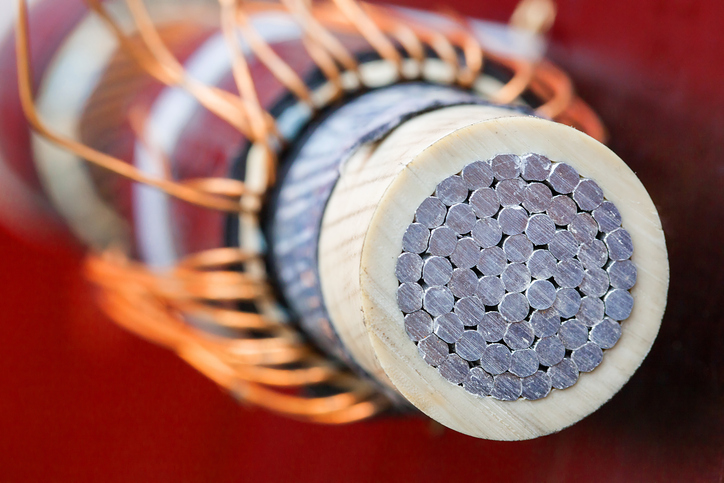
When engineers design wire and cable systems for motors, generators, and power applications, the insulation material they select has consequences that extend well beyond basic protection. At elevated voltages, insulation is asked to perform continuously under electrical stress that most materials degrade over time. Mica cable insulation has become the material of choice in these environments, not only because of its thermal properties, but because of what it delivers where it matters most: sustained dielectric performance under demanding high-voltage conditions.
Thermal Solutions Engineered for Your Application: Contact Electrolock to discuss high-temperature insulation challenges tailored to your thermal requirements.
What Makes High-Voltage Cable Insulation Different
General-purpose wire insulation manages relatively straightforward electrical loads. High-voltage cable insulation operates in a different category altogether. The primary concerns are dielectric strength — the ability to resist electrical breakdown — and partial discharge resistance, which determines how well the insulation holds up against the localized electrical discharges that occur within voids or at material interfaces under sustained high-voltage stress.
Partial discharge is an insidious failure mode. It doesn’t cause immediate breakdown, but it progressively erodes organic insulation materials from the inside, shortening service life and eventually leading to failure. In high-voltage applications — motors, generators, power cables, and traction systems — this is the failure mechanism that engineers most need to design against.
How Mica Performs as a Dielectric Insulator
Mica’s crystalline structure gives it an inherent advantage in high-voltage environments. Its layered, platelet-like form creates a naturally dense barrier to electrical conduction, resulting in high dielectric strength and, critically, exceptional resistance to partial discharge. Unlike organic polymer materials, mica does not degrade meaningfully under sustained electrical stress; it is inorganic, dimensionally stable, and maintains its insulative properties across a wide range of operating conditions.
Mica-based insulating materials are governed by IEC 60371, the international standard covering their definitions, test methods, and performance specifications. It’s a framework that reflects how seriously the industry takes its electrical properties. This combination of standards and inherent material performance makes mica cable insulation particularly well-suited to applications where voltage endurance over a long service life is the primary design requirement. For engineers who want to understand mica’s equally important role in fire and thermal protection — including its use in EV battery packs — our piece on thermal runaway protection in EV batteries covers that application in depth.
Key Applications for Mica Cable Insulation
The high-voltage wire and cable space encompasses several distinct application categories where mica cable insulation is commonly specified. In traction motor magnet wire, mica tape provides the dielectric protection needed to withstand the voltage stresses inherent in motor drive systems, including the fast-switching transients generated by modern power electronics. In downhole pump motors and cables, mica insulation must maintain performance in chemically harsh, high-temperature environments where conventional materials fail. Power and control cables in industrial and mass transit installations rely on mica for both its dielectric properties and its ability to maintain circuit integrity under fire conditions.
These applications share a common thread: they demand insulation that performs reliably over time, not just under initial test conditions.
Fire Survival Performance — A Complementary Strength
Dielectric performance is mica’s primary value in high-voltage cable applications, but its fire survival properties make it uniquely capable across a broader range of cable types. Electrolock’s Pyrodox® mica cable tapes are engineered for applications requiring both sustained electrical performance and the ability to maintain circuit integrity during a fire event. For a detailed look at Pyrodox® fire survival performance, construction variants, and UL certification capabilities, our piece on high-temperature cable insulation with mica cable tape covers that ground thoroughly.
Selecting the Right Mica Cable Insulation
Not all mica cable insulation is engineered the same way, and the right configuration depends on the specific demands of the application. Key variables include mica type — phlogopite and muscovite offer different balances of thermal and electrical properties — backing material, binder chemistry, tape construction, and slit width. These choices affect everything from how the tape handles during manufacturing to how it performs under voltage stress in service.
Electrolock’s engineers work directly with cable manufacturers and design teams to navigate these variables, drawing on a broad material library and comprehensive testing capabilities to validate performance before production commitments. For a broader look at how mica compares to other insulation material families, our overview of types of electrical wire insulation provides useful context.
Partner With Electrolock on Your Mica Cable Insulation Needs
With more than 65 years of engineering insulation solutions for high-voltage wire and cable applications, Electrolock brings both material depth and application knowledge to every project. Whether the challenge is voltage endurance in a traction motor system, dielectric performance in a downhole cable, or fire survival in a critical power circuit, our team works alongside yours to develop the right solution.
Contact Electrolock to discuss your wire and cable insulation requirements, or explore our full range of high-temperature wire and cable solutions to see what’s available.


